
February 7 Editorial in the Park Record
Treasure: Just because you can doesn’t mean you should
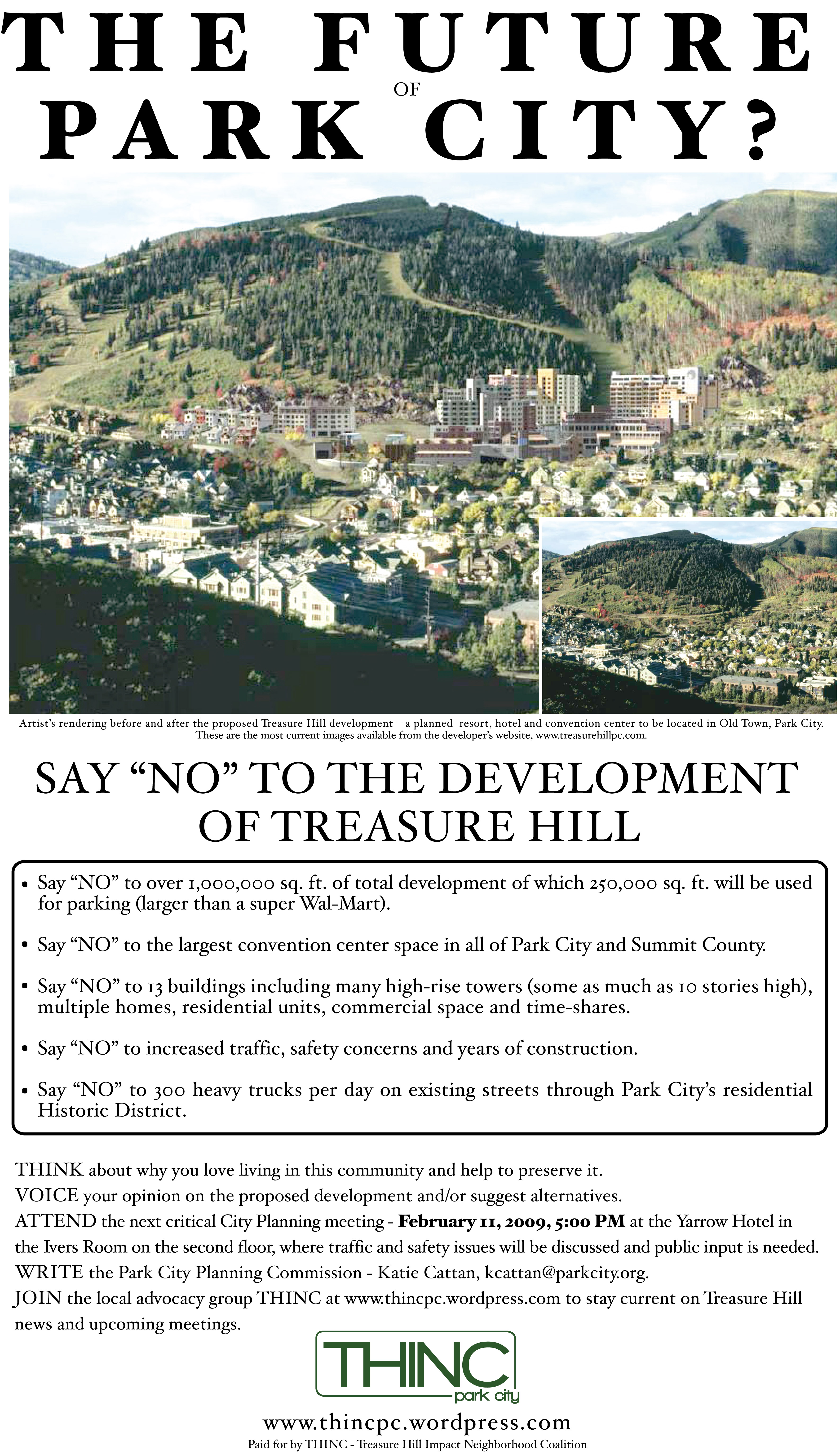
The Park Record in recent months has received a barrage of telephone calls and emails imploring the newspaper to make citizens aware of the enormity of the proposed Treasure development planned for the hillside west of Old Town. The Park City Planning Commission is scheduled to hold a work session at 5 p.m. and a public hearing at 7 p.m. about the project this Wednesday, Feb. 11, at The Yarrow hotel at 7 p.m.
The rendering itself, on the front page of this edition, should serve as an urgent call to action.
Based on current economic and environmental concerns, and the city’s growing battle with traffic congestion, we believe most residents would oppose putting 200 hotel rooms and 100 condominiums, along with commercial and meeting space, on the slopes above the steep, narrow streets of Old Town.
Property owners, especially those who own or manage local businesses, are keenly aware of the impact all of the new hotels, condos and commercial establishments already have had on the limited labor pool. While it is unlikely the developers of Treasure will build all of the project at once, each increment will put more stress on the city’s already inadequate employee-housing inventory.
Another immediate concern about the project is its inevitable traffic impact. Old Town and Deer Valley already comprise a sizeable bubble at the end of a narrow bottleneck. Adding another bulge to an already strangled commercial intersection could constitute a fatal blow to Main Street’s ambiance.
But the most glaring criticism of the project is its resemblance to the financial excesses that are now taking their toll on the national economy. The scope of Treasure may be financially feasible in some future superheated economy, but is far beyond what is appropriate for the community.
But, the difficult decision facing the Planning Commission is not whether Park City can sustain another vast project, it is how to mitigate a behemoth approval that is now more than 20 years old.
While the city and planning commission may be legally obligated to honor the previous approval density, the Sweeneys do not have to demand it. For the same reason that Wall Street executives are now being vilified for taking advantage of a self-destructive system, the Sweeney legacy could be the monstrosity they insist on building. Or they could voluntarily release the city and its residents from what should be an obsolete approval.
On one hand, the Sweeneys have a lot to gain financially by holding Park City to its legally binding agreement. They could sell off each parcel with its bloated density to the highest bidder and then hightail it out of town. On the other hand, we can only hope that they would find greater value in protecting the intrinsic worth of the land by proposing a significantly smaller development.
 THINC Park City